Why Most AI Agents Fail in Production
Everyone's building AI agents. Almost none of them work reliably. Here's what I've learned building production agent systems.
Everyone's building AI agents. Almost none of them work reliably. Here's what I've learned building production agent systems.
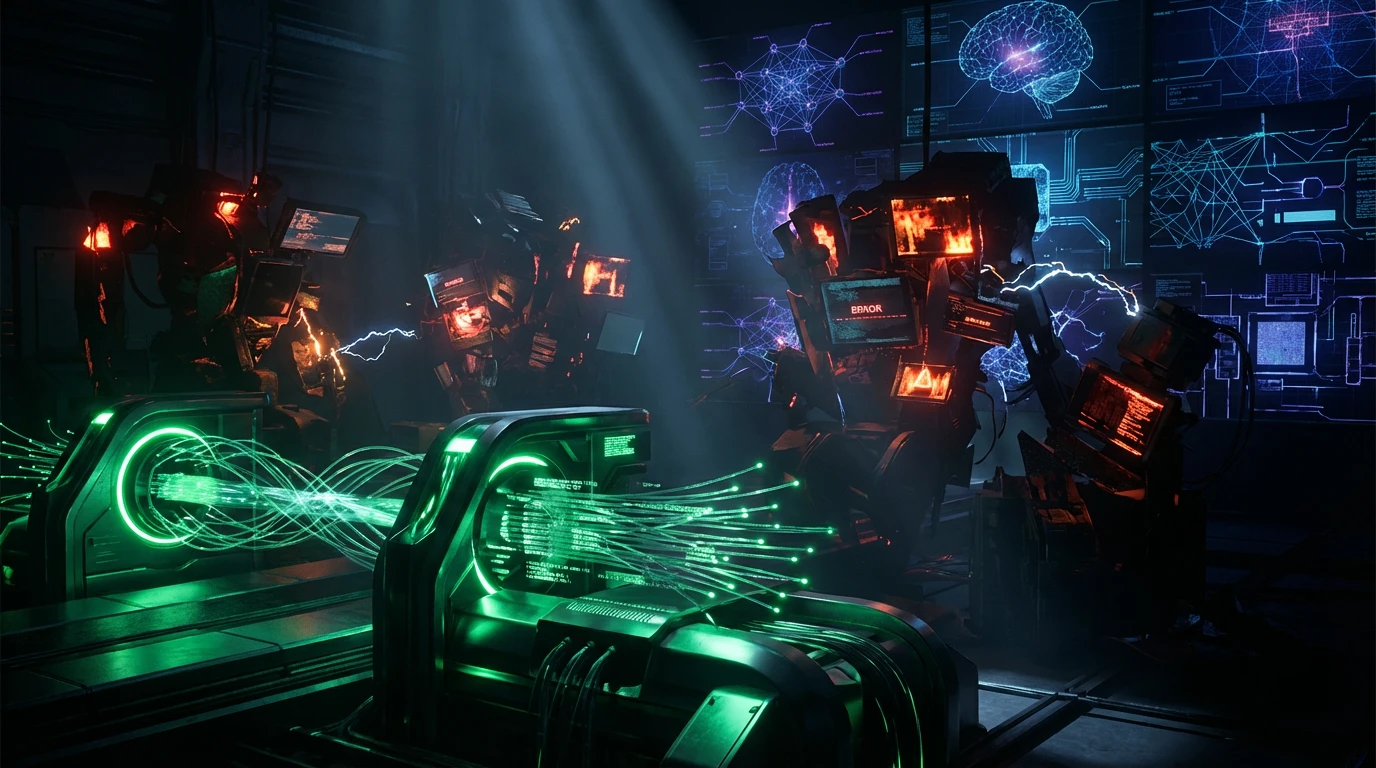
Everyone's building AI agents now. Every startup pitch deck has "AI agents" somewhere. Every enterprise is experimenting with "autonomous workflows."
Most of them will fail. Not because the LLMs aren't good enough — they are. But because people fundamentally misunderstand what it takes to run agents in production.
I've been building an agent orchestration platform. Here's what I've learned.
Demo agent: "Ask it anything, watch it figure out the answer!"
Production agent: Needs to handle edge cases, not hallucinate, stay within budget, be auditable, recover from failures, and work reliably thousands of times a day.
These are completely different problems.
The demo optimizes for "wow." Production optimizes for "boring reliability." Most teams never make the transition.
The biggest mistake: letting the LLM control the flow.
"Here are some tools. Figure out what to do."
This works in demos. In production, it means:
The insight that changed everything for me: separate control flow from reasoning.
The workflow decides what steps run in what order. The LLM reasons within bounded steps. (I wrote more about this in Why Your AI Needs Deterministic Workflows.)
BAD:  LLM → decides everything → unpredictable chaos
GOOD: Workflow → bounded LLM steps → deterministic paths with flexible reasoning
The LLM is powerful. But power without constraints is dangerous in production.
Most agents have no memory. Every conversation starts fresh. Or they dump the entire conversation history into context, which gets expensive and eventually overflows.
Better approach: distinguish between different types of memory. (I go deeper on this in Building AI That Actually Remembers.)
Short-term: Current conversation. Recent messages.
Episodic: What happened in past sessions. "Remember when we debugged that auth issue?"
Semantic: Facts and entities. Structured knowledge with provenance.
Procedural: Instructions, policies, preferences. The rules the agent follows.
These require different storage, different retrieval, different update patterns. Treating them all as "just throw it in a vector database" doesn't work.
LLMs are expensive. An uncontrolled agent can burn through hundreds of dollars in minutes.
I've seen it happen:
You need hard limits:
These aren't optional. They're survival. (More on this in The Cost Problem in AI Nobody Talks About.)
Agent does something wrong. Customer complains. You ask: "What happened?"
If you can't answer that question in 5 minutes, your agent isn't production-ready.
Requirements:
Most agent frameworks give you none of this. You're flying blind.
"Let's add an AI agent to handle customer support."
Cool. Did you think about:
Agents aren't features. They're team members. They need identity, permissions, governance, and oversight. (I explore this mental model in Agents as Colleagues, Not Features.)
After building this for a while, here's what I've found works:
The workflow is a graph. Nodes can be:
The graph is fixed. The LLM operates within nodes. You get predictability + flexibility.
Every execution has limits:
If limits are hit, execution stops gracefully. You'd rather fail predictably than succeed unpredictably.
After each node completes, checkpoint the state. If execution crashes, resume from checkpoint.
Hot checkpoints in Redis (active executions). Cold storage in your database (historical).
Crash recovery isn't optional for production systems.
Every execution produces:
When something goes wrong, you can see exactly what happened.
Some decisions shouldn't be fully automated:
Build approval gates into your workflows. Route sensitive decisions to humans. The agent proposes, the human approves.
After iterating on this, here's roughly what the stack looks like:
API Layer (request handling, auth, streaming)
    ↓
Worker Layer (async execution, background jobs)
    ↓
Workflow Engine (DAG execution with cycle support)
    ↓
Intelligence Layer (LLM calls, tool execution, RAG)
    ↓
Storage (relational + graph + vector, unified)
Each layer has clear responsibilities. The workflow engine handles execution logic. The intelligence layer handles AI. They don't bleed into each other.
Building the agent is maybe 20% of the work.
The other 80%:
These aren't exciting. They're essential.
AI agents are powerful. But "powerful" and "production-ready" are different things. The teams that succeed will be the ones who treat agents as serious infrastructure, not magic demos.